Material Properties Governing Handling Strategies
Updated to manuscript V3
The review groups formulation materials by how they are handled: liquids (pipetted or pumped), semi-solids (yield stress or viscosity high enough to require extrusion) and powders (particulate solids) [13], [14]. Its Table 1, reproduced on Dispensing by Material Class, gives the working ranges used throughout this wiki: low-viscosity liquids 1–20 cP, medium 20–500 cP, high 500–100,000 cP; gels with yield stress ~10–500 Pa; pastes ~100–10,000 Pa, often thixotropic; powders from free-flowing (Hausner ratio ~1.00–1.11) to very cohesive (>1.4), with angles of repose from ~25° to >66°. Industry characterizes semi-solids at two representative shear rates (low, ~1–10 s⁻¹, and high, ~100–1000 s⁻¹) rather than the full flow curve [19]; tribocharging [35] and humidity drive wall adhesion in powders.
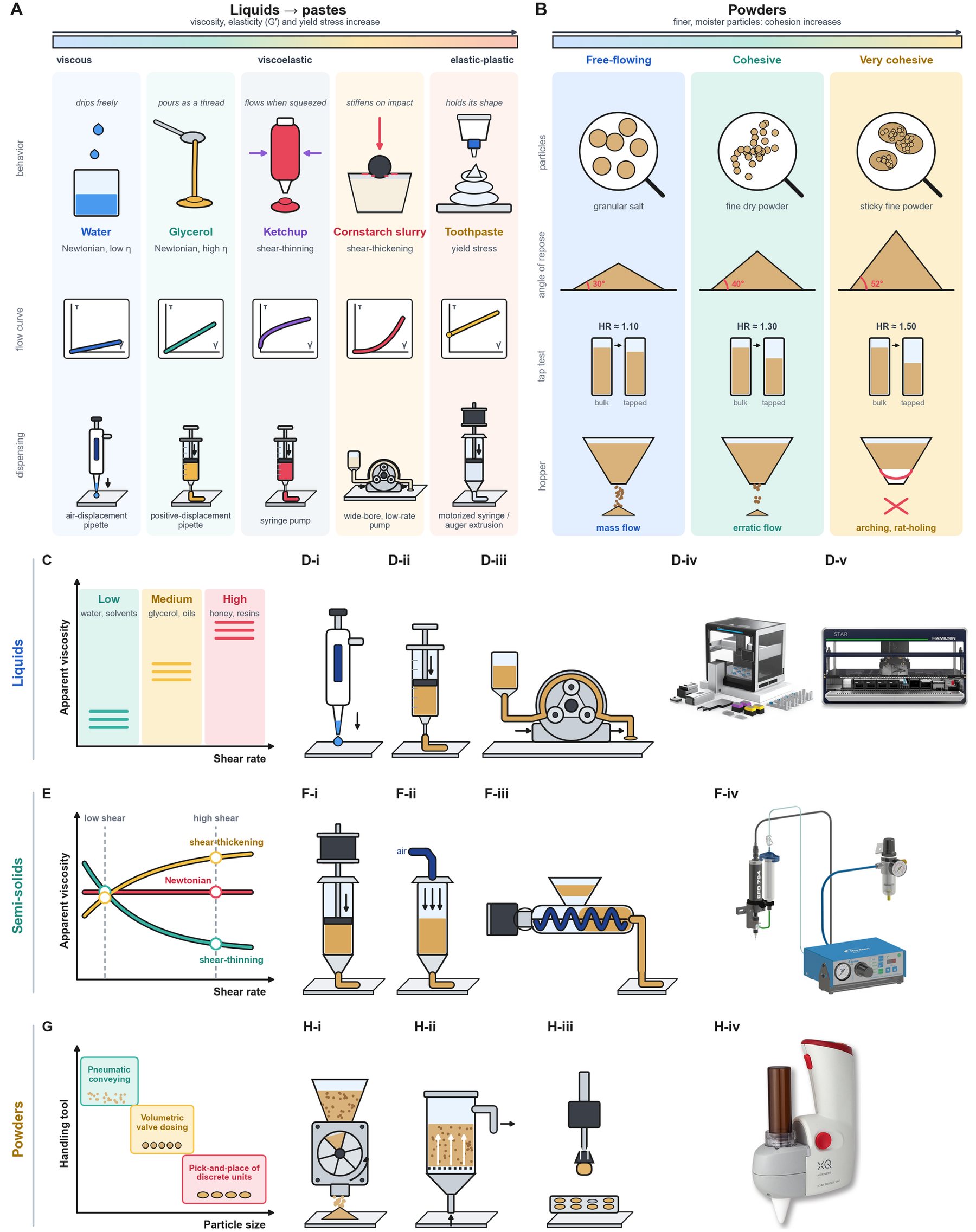
Overview
The key physical properties of liquids, semi-solids, and powders determine which automated handling strategy is most appropriate. Materials span a continuum from low-viscosity Newtonian liquids to highly viscous pastes, yield-stress fluids, powders, and solid dosage forms.
Rheological Properties
Viscosity and Flow Behavior
Viscosity is the dominant parameter governing automated liquid dispensing because it directly influences:
- Pressure losses
- Flow stability
- Droplet formation
- Achievable volumetric accuracy
Newtonian fluids (constant viscosity) are easier to pump and dispense. Examples: water (~1 cP), glycerol (~1500 cP).
Non-Newtonian fluids exhibit viscosity that changes with shear rate: - Shear-thinning materials become less viscous at high shear (e.g., polymer solutions, food sauces) - Shear-thickening materials harden under stress (rare in labs) - Yield-stress (Bingham) fluids behave like solids until applied stress exceeds their yield point (e.g., certain gels, pastes)
Yield Stress
Materials with yield stress require sufficient force or shear to initiate flow. Handling these requires: - Pumps or robotic actuators that provide enough force - Feedback loops to detect when flow starts - Special dispensing strategies (sense→estimate→act; watch→detect→correct)
Standard air-displacement pipettes typically fail above ~100 cP viscosity.
Semi-Solids and Gels
Semi-solid materials (pastes, adhesives, bio-inks) often combine: - Viscous behavior at rest (storage) - Elastic behavior under stress (recovers shape) - Yield stress below which they behave like a solid
Industry characterizes them at two representative shear rates: - Low shear (storage, gentle handling) - High shear (extrusion, spraying)
Rather than sampling the full flow curve.
Powder Properties
Powder handling depends on multiple interrelated properties:
Flowability Metrics
- Angle of repose — the angle at which a powder forms a stable pile
- Hausner ratio — ratio of tapped to poured bulk density
- These reflect interparticle friction and cohesion
Particle Size Distribution
- Very fine powders (dust-like, < 100 µm) may require fluidized or vacuum-assisted feeding
- Coarse granules may not compact well and flow more readily
- Cohesive fines can agglomerate or bridge, making dosing unpredictable
Surface Interactions
- Electrostatic charge (tribocharging) causes powders to cling to surfaces
- Moisture sensitivity — hygroscopic powders absorb water, changing flowability
- Surface area affects interparticle forces
Common Failure Modes
- Bridging (arch formation) — powder gets stuck in the hopper
- Rat-holing (funnel flow) — flow channels through the powder, leaving unmixed material
- Caking — compaction due to moisture or pressure
Table: Material Properties and Handling Implications
| Property | Low-Viscosity Liquid | High-Viscosity Liquid | Gel/Paste | Free-Flowing Powder | Cohesive Powder | Solid |
|---|---|---|---|---|---|---|
| Viscosity (cP) | 1–20 | 100–100,000 | Yield-stress | N/A | N/A | N/A |
| Yield Stress | None | None | 10–10,000 Pa | None | Variable | High |
| Handling Challenge | Splashing | Stringing, air bubbles | Pressure lag, yield stress | Cohesion, electrostatics | Bridging, rat-holing | Grasp reliability |
| Typical Strategy | Characterize (viscosity) | Iterative optimization | Real-time correction | Simulation generalization | Real-time correction | Tactile retrieval |
| Sensing Need | Low | Medium (temperature, flow) | Medium (pressure) | High (vision, weight) | High (weight, fill height) | High (touch, force) |
References
- Rastegardoost, M. M.; Bao, Z.; Sadr, S.; Abdollahi, N.; Darvish, K.; Clasky, A.; Ohsaka, H.; Le Devedec, F. Self-Driving Laboratories for Formulation: Handling Liquids, Pastes, Powders and Objects, from Robots to Digital Twins and AI Agents. Manuscript in preparation, 2026.
- Key references from the review: [13], [14], [19], [20], [30], [35]. Full list on the References page.
Further reading (from the earlier wiki)
- Tadros, T. F. (2010). Rheology of Dispersions: Principles and Applications. Wiley-VCH.
- Mezger, T. G. (2020). The Rheology Handbook (5th ed.). Vincentz Network.
- Barnes, H. A. (2000). A Handbook of Elementary Rheology. University of Wales Institute.
- Malkin, A. Y., Derkach, S. R., & Kulichikhin, V. G. (2023). Rheology of gels and yielding liquids. Gels, 9(9), 715.