Data & Decision Models
Step 7 · Decide: What to make next?
This page summarizes Sections 8.1–8.2 of the review. Language models and agents are covered on LLMs & AI Agents. The earlier wiki page Machine Learning has practical model-training guidance.
A formulation SDL that can dose, move, mix, rehearse and orchestrate still needs something to decide what to make next. Every such decision depends on the data, models and strategies behind it.
What a formulation experiment records
One experiment produces several kinds of data:
| Kind | Examples |
|---|---|
| Scalars and labels | The recipe and its outcome |
| Time series | Balance readings, extrusion pressure, mixing torque, temperature, or the signal of a self-powered sensor [131] |
| Spectra and curves | Rheological flow curves, UV-vis or infrared spectra, the acoustic-to-electrical response of an energy-harvesting composite [132] |
| Images and video | Foam, phase separation, droplets or powder, as in the vision-guided scenarios [12], [28], [33] |
| Metadata | Ingredient lots, instrument settings, trajectories and provenance |
The data can also be split by how quickly it is used:
- Process data has to be acted on by the controller within seconds (see Feedback Control).
- Property data is what the planner learns from between experiments.
When experiments are stored as FAIR (findable, accessible, interoperable and reusable) records [133], every experiment can be reused, not just its headline result.
Surrogate models and acquisition strategies
The simplest use of these data is a surrogate model. It maps composition and process parameters to measured properties, replacing the lookup table with a prediction.
The decisive step is choosing the next experiment. An acquisition function ranks candidate experiments using the surrogate's predictions and their uncertainty:
- Active learning samples where the model is least certain [134].
- Bayesian optimization balances that uncertainty against predicted performance to reach good formulations in few experiments [135]. Libraries such as BoTorch make both routine [136].
- For small, low-dimensional problems, simpler sequential methods such as simplex optimization still work well [151].
These methods matter most when time, material or instrument hours are scarce, which they always are in a formulation SDL. The handling studies already use them:
- viscous pipetting [11];
- powdered-beverage reconstitution [42];
- Cao et al. combined a classifier with multi-objective Bayesian optimization on robotic platforms and found nine suitable commercial liquid formulations in 15 working days [137].
Handling data belongs in the objective
Engineering measurements such as a dispensing error, a torque trace or a rheology curve can go directly into the objective or the constraints. The planner then learns which recipes the hardware can make reliably, not only which ones perform well.
The decision ladder
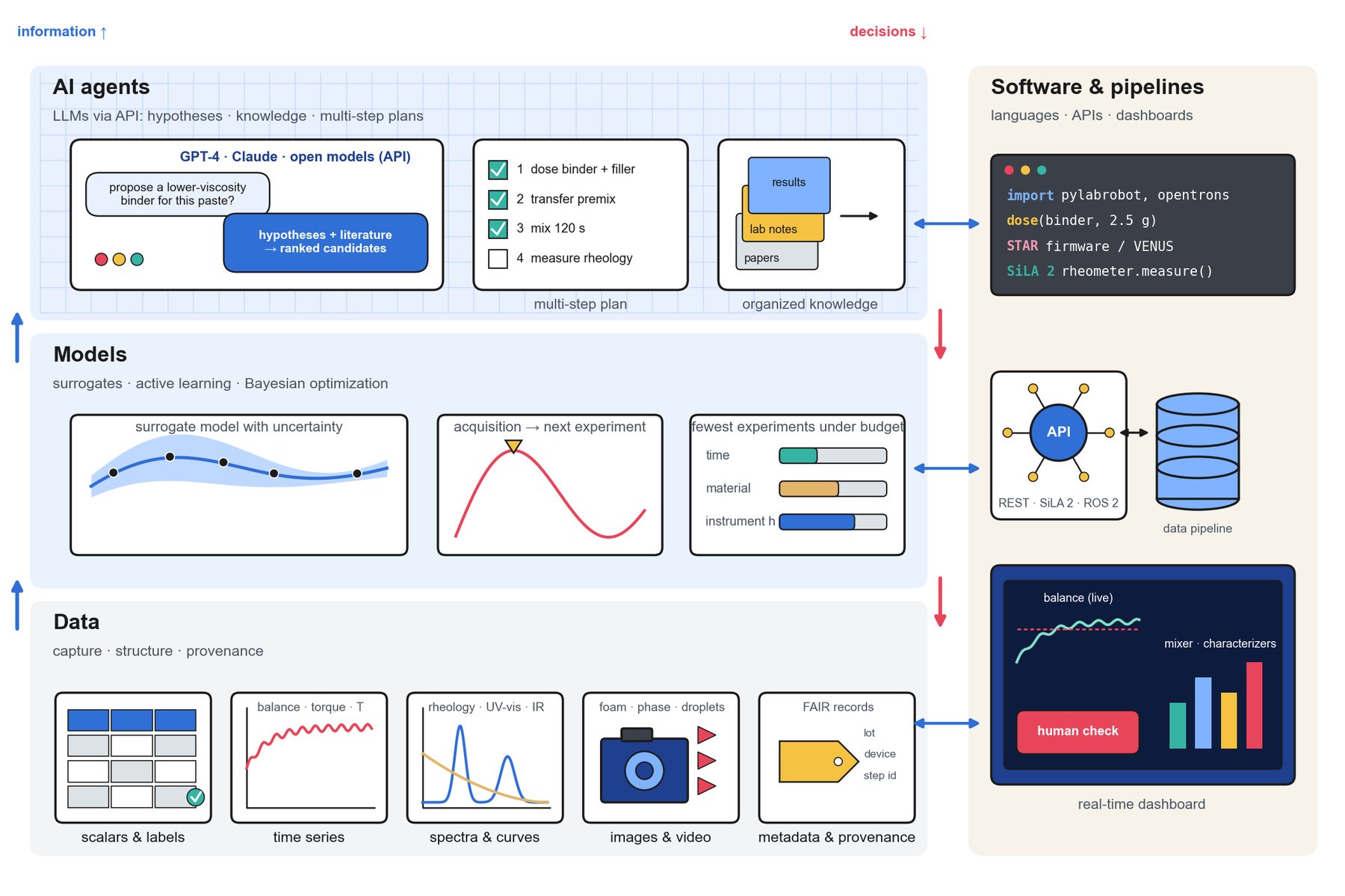
Data, models and agents form a ladder of decision making (Fig. 9):
- structured data;
- models that choose the next experiment;
- agents that plan whole workflows.
Each rung needs more from the data beneath it, and that is where handling comes back in: a planner can only learn from a dose that was actually delivered and a premix that was actually mixed. Continue to LLMs & AI Agents.