Companion wiki · Manuscript V3
Self-Driving Laboratories for Formulation
How a self-driving lab doses liquids, pastes and powders, moves the containers that hold them, rehearses each step in a digital twin, and decides what to make next.
This wiki is a browsable, living companion to the review Self-Driving Laboratories for Formulation: Handling Liquids, Pastes, Powders and Objects, from Robots to Digital Twins and AI Agents. It follows the review's seven steps and includes its tables, all ten figures and 178 linked references.
Formulation means combining ingredients into products whose properties depend on both composition and process. An autonomous formulation experiment is a physical choreography:
- ingredients with very different rheology are dosed into one premix container;
- the container is carried to a mixer;
- the mix is processed and characterized, often with materials the robot has never handled.
Landmark SDLs show that this physical layer can limit autonomy as much as the planning algorithm does [3], [4]. The guiding question at every step is how should this material, in this container, be handled next?
Liquids Semi-solids Powders Objects
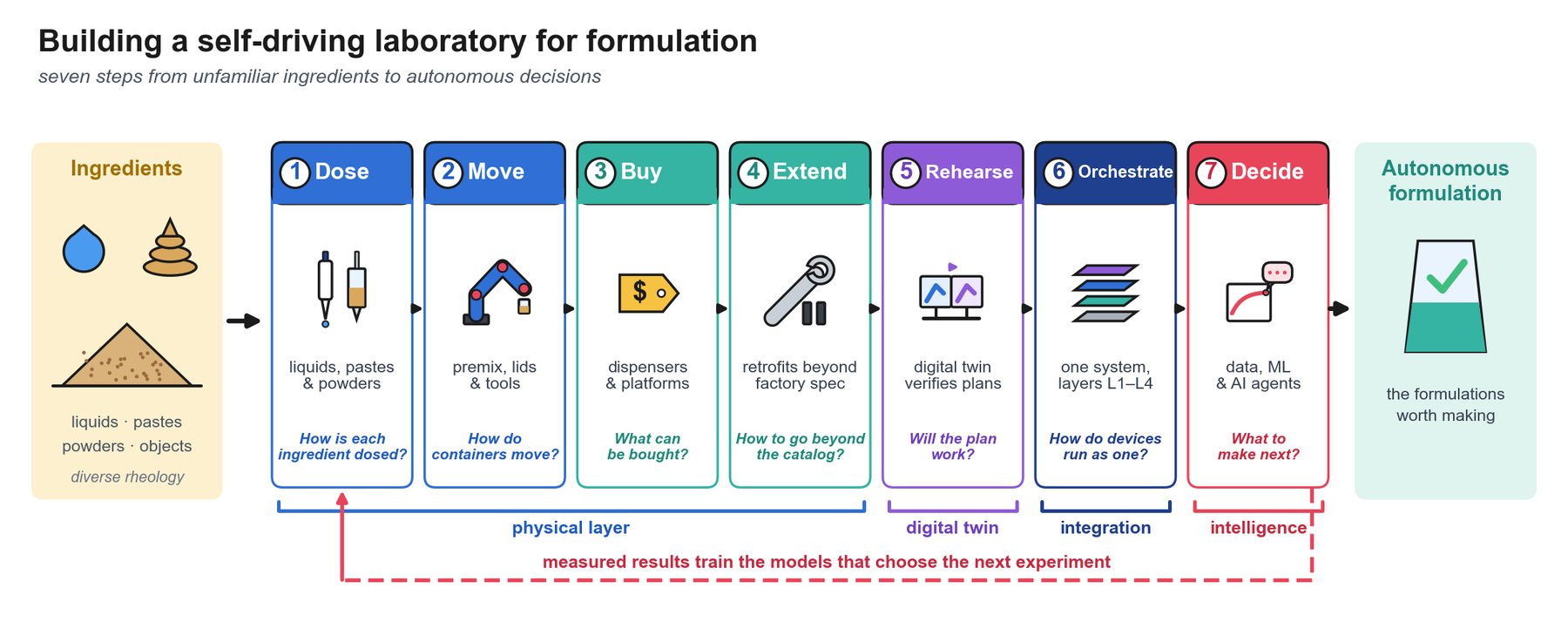
The seven steps
1 Dose How is each ingredient dosed? Materials, dispensing, 20 scenarios, strategies
2 Move How do containers move? Gantries, SCARA, arms, cobots, mobile manipulators
3 Buy What can be bought? Dispensers and integrated platforms by accuracy and price
4 Extend How to go beyond the catalog? Retrofits: end-effectors, sensors, control software
5 Rehearse Will the plan work? Fidelity hierarchy, simulators, digital twins
6 Orchestrate How do devices run as one? Layers L1–L4, interfaces, eight open-source systems
7 Decide What to make next? Data, surrogates, Bayesian optimization, AI agents
Where to start
| I want to... | Go to |
|---|---|
| Understand liquids, gels and powders | Material Properties · Material Spectrum |
| See which strategy suits my material | Recurring Strategies · Literature Scenarios |
| Compare commercial dispensers by accuracy and price | Commercial Dispensers · Integrated Platforms |
| Choose a robot to move premix containers | Robot Classes |
| Extend a liquid handler past its factory spec | Retrofits |
| Rehearse a workflow before committing material | Simulation & Digital Twins |
| Pick orchestration software | Open-Source Orchestration Software |
| Use ML and AI agents safely | Data & Decision Models · LLMs & AI Agents |
| Understand safety and the outlook | Safety · Future Directions |
Citation
Self-Driving Laboratories for Formulation: Handling Liquids, Pastes, Powders and Objects, from Robots to Digital Twins and AI Agents
Mohammad M. Rastegardoosta,*, Zeqing Baoa, Sara Sadra, Nasim Abdollahia, Kourosh Darvisha, Aaron Claskya, Hiroki Ohsakab, Frantz Le Devedeca
a University of Toronto, Toronto, ON, Canada · b SEKISUI Chemical Co., Ltd., Osaka, Japan
* Corresponding author: m.rastegardoost@utoronto.ca
Manuscript in preparation, 2026.
@unpublished{rastegardoost2026formulation,
  title  = {Self-Driving Laboratories for Formulation: Handling Liquids, Pastes, Powders and Objects, from Robots to Digital Twins and AI Agents},
  author = {Rastegardoost, Mohammad M. and Bao, Zeqing and Sadr, Sara and Abdollahi, Nasim and Darvish, Kourosh and Clasky, Aaron and Ohsaka, Hiroki and Le Devedec, Frantz},
  note   = {Manuscript in preparation},
  year   = {2026}
}
This is a living, open-source wiki. See Contributing to add case studies, strategies or products, and the Changelog for what has changed.